

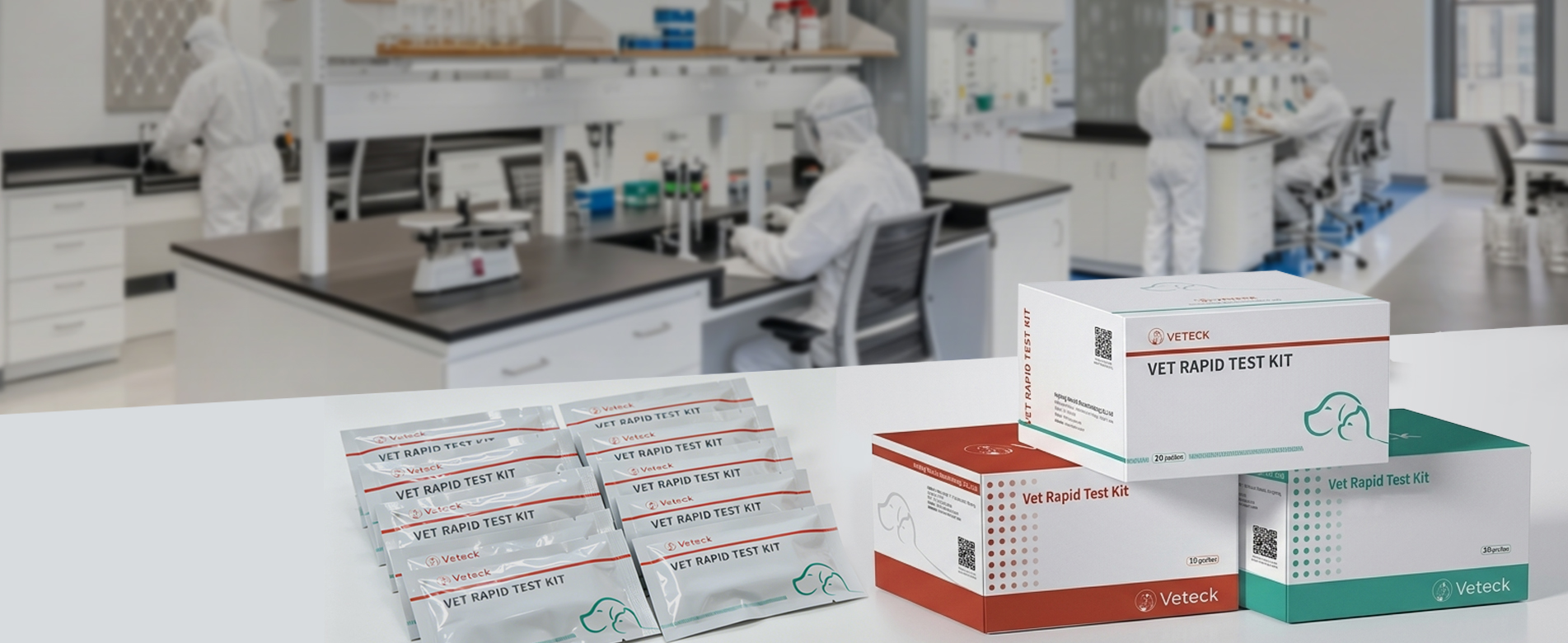
Why Can an FIP Antigen Rapid Test Give a False Positive?

Deeply cultivating precise vet diagnostics, empowering smart medical services
A positive FIP antigen test can be confusing, especially when a cat has no obvious signs of feline infectious peritonitis (FIP). However, a positive antigen result does not automatically mean that the cat has FIP. The key issue is what the test actually detects.
Most rapid antigen tests for feline coronavirus (FCoV) detect viral components such as the nucleocapsid (N) protein. This protein is present in both the common feline enteric coronavirus (FECV) and the mutated virus associated with FIP. Therefore, the presence of viral antigen confirms FCoV detection, but it does not by itself prove that the virus has caused FIP.
For veterinary laboratories, clinics, distributors, and diagnostic product buyers, understanding this distinction is essential. It affects how a FIP antigen rapid test kit should be positioned, how positive results should be interpreted, and when additional diagnostic methods are needed.
What Does an FIP Antigen Test Actually Detect?
FCoV is common among cats, particularly in multi-cat environments. The virus primarily replicates in intestinal tissues and may cause no clinical signs or only mild gastrointestinal symptoms. In a small proportion of infected cats, viral evolution and host factors can contribute to the development of FIP.
The important point is that an antigen rapid test generally detects a viral protein rather than directly identifying the biological changes responsible for FIP. This is why a positive result must be interpreted together with the cat's clinical condition and other laboratory findings.
| Feature | Feline Enteric Coronavirus (FECV) | FIP-associated Coronavirus |
|---|---|---|
| Occurrence | Common, particularly in multi-cat environments | Uncommon compared with FCoV infection |
| Typical clinical effect | Often asymptomatic or mild intestinal disease | Progressive systemic disease |
| Antigen presence | Can be detected | Can be detected |
| Can a routine antigen test distinguish them? | No | No |
This is the main reason why a positive FCoV antigen result should not be treated as a stand-alone FIP diagnosis.
Why Are Positive Results Common in Multi-Cat Environments?
The testing environment has a major influence on the meaning of a positive result. FCoV transmission is facilitated by close contact and shared litter areas, making multi-cat households, shelters, and breeding facilities particularly important settings for viral circulation.
The original data used in this article indicate that FCoV prevalence may range from approximately 50% to 80% in multi-cat households, while breeding catteries may approach 100% exposure or circulation in some studies. In comparison, prevalence in private households is substantially lower.
| Environment | Reported FCoV Prevalence | Testing Implication |
|---|---|---|
| Private households | Approximately 15% | Positive results require clinical context |
| Multi-cat households | Approximately 50–80% | Positive antigen detection may reflect common FCoV circulation |
| Breeding catteries | Up to approximately 100% | A positive result has limited value for diagnosing FIP by itself |
Illustrative FCoV prevalence by environment
Private households — ~15%
Multi-cat households — 50–80%
Breeding catteries — up to ~100%
For veterinary diagnostic manufacturers and distributors, this also means that product claims should be carefully worded. A test designed to detect FCoV antigen should not be marketed as a definitive FIP confirmation method unless its intended use and validation data specifically support that claim.
Four Common Reasons for an Unexpected Positive Result
1. Detection of Common FCoV
This is often the most important explanation. The test may be working exactly as intended by detecting FCoV antigen. The result becomes misleading only when the positive line is interpreted as proof of FIP.
2. High Viral Shedding
Cats in shelters, breeding facilities, and multi-cat households can experience substantial FCoV circulation. When viral shedding is high, antigen detection becomes more likely. In these environments, a positive result should be interpreted against the background prevalence of FCoV rather than considered independently.
3. Cross-Reactivity and Non-Specific Binding
Immunochromatographic assays rely on antibody-antigen interactions. Depending on assay design, sample composition, antibody specificity, and manufacturing quality, cross-reactivity or non-specific binding may contribute to unexpected results.
For buyers evaluating a feline coronavirus antigen test kit, this is why analytical specificity should be reviewed alongside sensitivity. A high analytical sensitivity alone does not guarantee reliable clinical interpretation.
4. Sample and Operator Factors
Rapid tests are affected by sample quality, extraction procedures, storage conditions, test timing, and interpretation. Fecal samples, for example, contain complex biological material that can interfere with lateral-flow assays if sample preparation is inconsistent.
| Factor | Potential Problem | Recommended Control |
|---|---|---|
| Sample quality | Matrix interference or insufficient target material | Standardized collection and extraction |
| Storage | Target degradation or altered sample characteristics | Follow validated storage conditions |
| Test timing | Early or late reading may cause misinterpretation | Read within the specified time window |
| Operator technique | Incorrect sample volume or procedure | Clear instructions and operator training |
FIP Antigen Test vs Other Diagnostic Methods
No single laboratory test should be viewed as sufficient in every suspected FIP case. Different methods answer different diagnostic questions. Rapid antigen testing is useful for quick screening, while molecular testing, effusion analysis, immunohistochemistry, and other laboratory findings can provide additional evidence.
| Method | Main Target | Strength | Main Limitation |
|---|---|---|---|
| FCoV Antigen Rapid Test | Viral antigen | Fast and convenient | Cannot reliably distinguish FCoV from FIP-associated virus |
| Serology | FCoV antibodies | Useful for assessing exposure | Does not confirm FIP |
| RT-PCR | Viral RNA | High analytical sensitivity | Detection of RNA alone does not automatically establish FIP |
| Effusion Analysis | Protein, cells and viral markers | Useful in cats with effusion | Not applicable to every patient |
| IHC | Viral antigen in tissue | Highly specific when properly performed | Invasive and requires tissue sampling |
Published diagnostic comparisons show that reported sensitivity and specificity vary considerably by sample type, disease stage, assay design, and study population. For this reason, diagnostic performance should always be evaluated using the manufacturer's validation data rather than relying on one universal sensitivity or specificity number.
How Should a Positive FIP Antigen Test Be Interpreted?
The practical value of a positive test depends heavily on the clinical situation. A positive result in a clinically healthy cat has a very different meaning from a positive result in a cat showing persistent fever, weight loss, abdominal effusion, neurological abnormalities, or other findings compatible with FIP.
| Clinical Situation | Interpretation | Next Step |
|---|---|---|
| Healthy cat + positive antigen | Likely indicates FCoV detection or exposure | Monitor clinical status |
| Multi-cat environment + positive antigen | Higher probability of common FCoV circulation | Interpret with environmental and clinical information |
| Compatible clinical signs + positive antigen | Raises suspicion but is not definitive alone | Consider additional diagnostic evidence |
| Effusion + compatible signs + positive viral detection | Higher diagnostic concern | Combine effusion analysis and other laboratory findings |
What Should Veterinary Diagnostic Buyers Look for in an FIP Test Kit?
For veterinary clinics, diagnostic laboratories, distributors, and OEM buyers, evaluating an FIP test should go beyond the words “rapid” or “high sensitivity.” The intended use and validation data are more important for determining whether a product is appropriate for a particular market.
When sourcing a veterinary FIP diagnostic test kit, buyers should review the following specifications:
- Target antigen: Confirm exactly which viral protein or marker the assay detects.
- Sample type: Check whether the kit is validated for fecal, serum, plasma, effusion, or other specimen types.
- Analytical sensitivity: Review the lowest detectable concentration or relevant detection threshold where applicable.
- Analytical specificity: Examine cross-reactivity testing and interference studies.
- Clinical performance: Look for independent or manufacturer-generated validation data using an appropriate reference method.
- Operating conditions: Confirm storage temperature, shelf life, test time, sample volume, and kit stability.
- Quality control: Evaluate lot-to-lot consistency, internal controls, manufacturing standards, and documentation.
- Regulatory requirements: Make sure the product's intended use and regulatory status match the requirements of the target market.
A Positive Result Is a Diagnostic Clue, Not the Whole Diagnosis
The most important distinction is simple: detecting FCoV is not the same as proving FIP. Because common feline coronavirus is widespread, particularly in multi-cat environments, positive antigen results are expected in some populations.
Rapid antigen testing remains valuable because it can provide quick information at the point of care or during initial screening. Its value increases when the result is interpreted together with clinical signs, sample type, hematology and biochemistry findings, effusion characteristics, molecular testing, and other relevant evidence.
For veterinary diagnostic manufacturers and B2B buyers, the same principle applies to product selection. A reliable rapid test should be evaluated according to its target, validated performance, specimen compatibility, quality control, and intended clinical application—not simply by whether the test produces a positive or negative line.